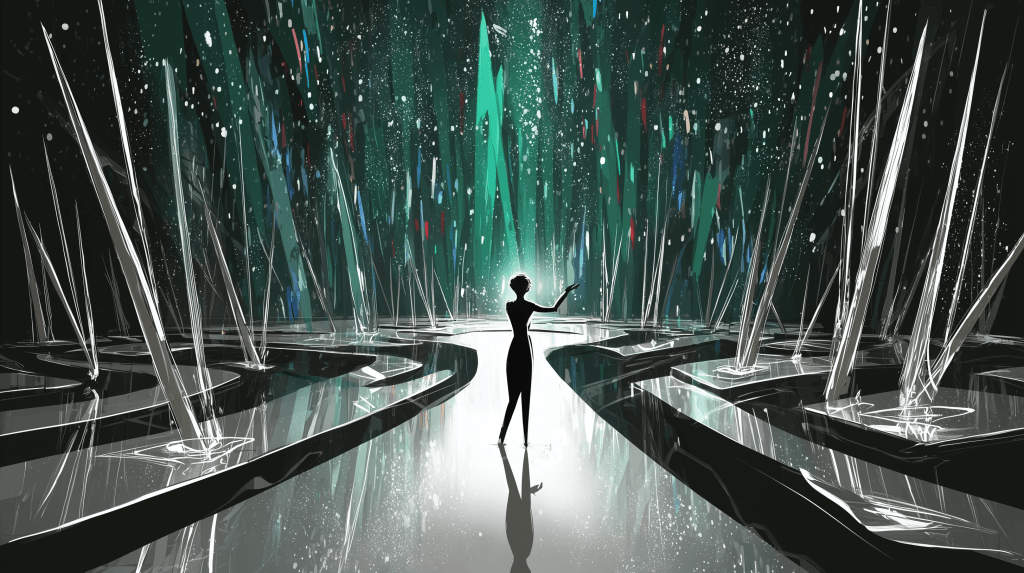
Maya stared at her monitor, watching an AI-generated sequence unfold for the hundredth time. The neural network had crafted a stunning chase scene through rain-soaked streets, complete with dynamic camera movements and atmospheric lighting that would have taken her team weeks to plan and execute. Yet something felt wrong. The technical mastery was undeniable, but the soul—her vision—seemed lost in the algorithmic precision.
“This isn’t filmmaking,” she muttered, reaching for the timeline scrubber. “This is just… efficient.”
Maya’s frustration captures the central tension facing today’s generative AI filmmakers: how do we harness the incredible power of artificial intelligence while preserving the human artistry that makes cinema compelling? The answer lies not in choosing between human and machine, but in finding the delicate balance where both can thrive.
The Promise and the Peril
Generative AI has transformed filmmaking workflows with breathtaking speed. Directors can now conjure entire worlds from text prompts, generate countless variations of a scene in minutes, and prototype complex sequences without massive budgets or crews. The technology offers unprecedented creative freedom—at least on the surface.
But as Maya discovered, freedom without intention can feel surprisingly hollow. When AI handles every creative decision, from composition to pacing, the filmmaker risks becoming a passive observer of their own vision. The auteur theory, which celebrates the director as the primary creative force behind a film, suddenly feels antiquated in an age where algorithms can paint, edit, and even score our stories.
Reclaiming Creative Control
The solution isn’t to abandon AI tools—that would be like refusing to use cameras because they’re not paintbrushes. Instead, successful AI filmmakers are learning to become “auteurs in the loop,” maintaining creative authority while leveraging artificial intelligence as an extension of their artistic vision.
Consider how director Jordan Hernandez approached his recent short film “Digital Dreams.” Rather than letting AI generate complete sequences, he used it strategically at specific creative junctures. When he needed to visualize a character’s memory fragments, he fed the AI carefully crafted prompts that reflected his thematic intentions, then manually selected and refined the outputs that best served his narrative.
“I treat AI like a incredibly talented but unpredictable collaborator,” Hernandez explains. “It can surprise me with ideas I never would have considered, but I’m still the one deciding which surprises make it into the final cut.”
The Art of Prompt Crafting
This human-in-the-loop approach requires developing new skills. Prompt engineering becomes as crucial as cinematography or editing. The most effective AI filmmakers learn to communicate their vision through language that guides artificial intelligence toward their creative goals while leaving room for serendipitous discoveries.
Sarah Chen, whose AI-assisted documentary “Traces” premiered at Sundance, describes her process as “conversational filmmaking.” She begins with broad thematic prompts, then iteratively refines them based on the AI’s responses, creating a dialogue between human intention and machine interpretation.
“The AI shows me possibilities I couldn’t have imagined,” Chen notes, “but I’m the one who recognizes which possibilities align with my story’s emotional truth.”
Maintaining Narrative Coherence
One of the biggest challenges in AI filmmaking is maintaining narrative coherence across generated content. While AI excels at creating individual moments of visual beauty, it struggles with the subtle continuity that makes stories feel unified and purposeful.
Successful auteurs in the loop develop systematic approaches to this challenge. They establish clear style guides and thematic frameworks before beginning generation, use consistent character descriptions and environmental details across prompts, and most importantly, maintain editorial control over how generated elements fit together.
Director Alex Thompson uses what he calls “creative constraints” to keep AI generation aligned with his vision. For his thriller “Neural Networks,” he developed a detailed visual language document that guided every AI prompt, ensuring consistency in tone, color palette, and symbolic imagery throughout the film.
The Human Touch in Post-Production
Perhaps nowhere is human creativity more essential than in post-production. While AI can generate raw material with remarkable efficiency, the selection, arrangement, and refinement of that material requires distinctly human judgment.
The most compelling AI-assisted films emerge from directors who use artificial intelligence as a generative tool but maintain hands-on control over pacing, emotional beats, and thematic development. They understand that AI can create content, but only humans can create meaning.
Embracing Imperfection
Interestingly, many successful AI filmmakers are learning to embrace the technology’s limitations as creative opportunities. When AI generates unexpected glitches, impossible geometries, or surreal juxtapositions, thoughtful directors incorporate these “errors” as stylistic elements that enhance their narratives.
“Some of my favorite moments in AI-generated footage are the ones that feel slightly off,” admits indie filmmaker Rosa Martinez. “There’s something haunting about the way AI occasionally breaks reality that I could never achieve with traditional techniques.”
The Future of Collaborative Creativity
As AI tools become more sophisticated, the role of the auteur in the loop will continue to evolve. The most exciting developments aren’t replacing human creativity—they’re amplifying it. New interfaces allow directors to guide AI generation through gesture, emotion, and even biometric feedback, creating more intuitive partnerships between human vision and artificial capability.
The key insight emerging from this technological revolution is that the best AI-assisted films don’t feel “made by AI”—they feel unmistakably authored by their human creators. The technology becomes invisible, serving the vision rather than overwhelming it.
Finding Your Balance
For filmmakers navigating this new landscape, the path forward requires both technical skill and artistic courage. Learn the tools, but don’t let them define your process. Use AI to expand your creative possibilities, but never abdicate your role as the primary architect of meaning and emotion.
The auteur in the loop isn’t diminished by artificial intelligence—they’re enhanced by it. They become conductors of a larger creative orchestra, where human vision guides artificial capability toward stories that could never have been told before.
Maya finally found her answer late that night, not by accepting or rejecting the AI-generated chase scene, but by recognizing what it was missing. She kept the dynamic camera work and atmospheric lighting, but manually adjusted the pacing to match her character’s emotional state, added subtle visual motifs that connected to earlier scenes, and made countless small decisions that no algorithm could make.
The result wasn’t just technically impressive—it was unmistakably hers. The auteur had found her place in the loop, and in doing so, had discovered new possibilities for cinematic storytelling that neither human nor machine could achieve alone.
In the end, the future of filmmaking isn’t about choosing between human creativity and artificial intelligence. It’s about learning to dance with both, keeping one foot firmly planted in human vision while allowing the other to explore the vast new territories that AI makes possible.
The director’s chair isn’t disappearing in the age of AI—it’s simply getting more interesting.
 AI Film Studio