Maya stared at her laptop screen at 2 AM, watching her classmate’s AI-generated short film unfold—a haunting tale of memory and loss that would have taken a Hollywood studio millions to produce just five years ago. She was thousands of miles away from the creator, yet felt more connected to their artistic vision than she ever had in traditional film school.
The landscape of film education is experiencing a seismic shift. While prestigious film schools still command six-figure tuitions and require physical presence, a new breed of online AI film school communities is democratizing cinematic storytelling in ways previously unimaginable.
The Birth of a New Educational Ecosystem
Traditional film education has long been gatekept by geography, finances, and institutional barriers. Students competed for slots at USC, NYU, or UCLA, often accumulating crushing debt for the privilege of learning on expensive equipment that would be obsolete within years.
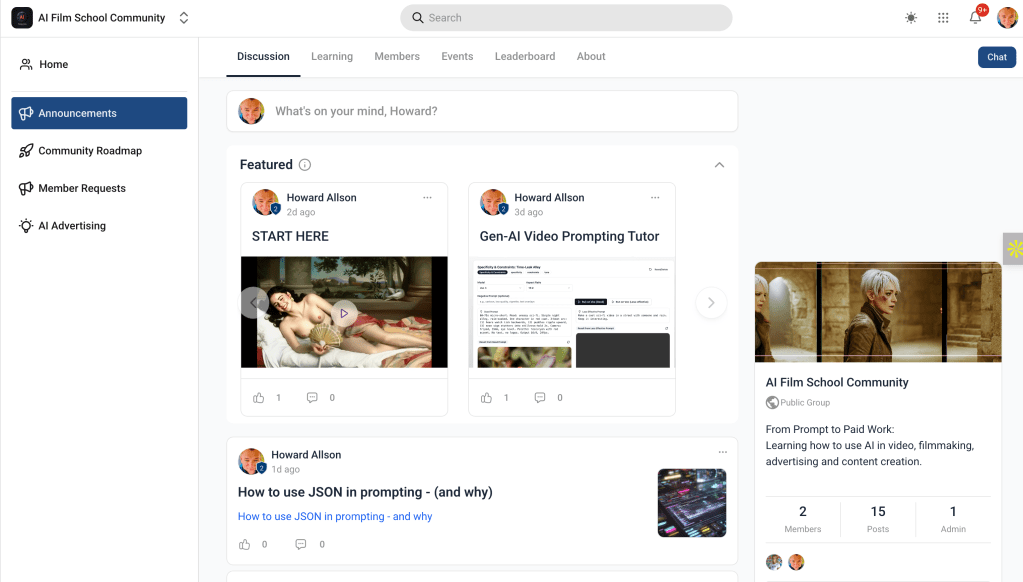
Enter the AI film school community—a digital-first educational model that’s fundamentally reshaping how we learn cinematic arts. These aren’t just online courses; they’re vibrant ecosystems where aspiring filmmakers from Lagos to Louisville collaborate, critique, and create using cutting-edge AI tools that level the playing field.
The story of Alex Chen illustrates this transformation perfectly. A software engineer in Singapore with a passion for storytelling, Alex couldn’t abandon their career to attend traditional film school. But through joining an AI film community, they learned to craft compelling narratives using AI-assisted scriptwriting, generate stunning visuals with text-to-image models, and create professional-quality soundscapes—all while maintaining their day job. Within six months, Alex’s AI-assisted short film “Digital Dreams” was accepted into three international film festivals.
What Makes These Communities Different
Real-Time Collaboration Across Continents
Unlike traditional film schools where projects are confined to semester schedules and physical locations, AI film communities operate in perpetual motion. Members from different time zones contribute to projects around the clock, with AI tools facilitating seamless collaboration. A writer in Brooklyn can script a scene, have it visualized by an artist in Berlin, and scored by a composer in Tokyo—all within 24 hours.
Hands-On Learning with Cutting-Edge Tools
These communities provide immediate access to the latest AI filmmaking technologies:
- Runway ML for video generation and editing
- Midjourney and Stable Diffusion for concept art and storyboarding
- ElevenLabs for voice synthesis and dubbing
- ChatGPT and Claude for script development and story structure
Members don’t just learn about these tools—they use them daily, building portfolios that showcase genuine proficiency with tomorrow’s filmmaking technology.
Industry-Connected Mentorship
Many AI film communities are led by working professionals who’ve successfully integrated AI into their commercial work. Unlike academic professors who may lack current industry experience, these mentors provide real-world insights into how AI is actually being used in production studios, advertising agencies, and streaming platforms.
The Learning Revolution in Action
Consider the story of the “Global Voices” project—a collaborative anthology series created entirely within an AI film community. Twelve filmmakers from six continents contributed episodes, each using AI to overcome traditional production limitations. A filmmaker in rural Kenya used AI voice synthesis to create professional-quality narration in multiple languages. A student in Mumbai generated photorealistic environments that would have required expensive location shoots. The result wasn’t just a film—it was proof of concept for a new model of global cinematic collaboration.
Curriculum That Evolves Weekly
Traditional film schools update their curricula every few years. AI film communities update theirs weekly, sometimes daily. When OpenAI releases a new model or Adobe integrates AI into Premiere Pro, community members are experimenting with it within hours, sharing discoveries and techniques in real-time.
This rapid iteration means students graduate with skills that are immediately relevant rather than potentially outdated. They’re not just learning current AI tools—they’re developing the adaptability to master whatever comes next.
Breaking Down Barriers
Geographic Freedom
Location is no longer destiny in film education. Talented storytellers in underserved regions can now access the same quality instruction and networking opportunities as their counterparts in major film centers. This geographic democratization is already producing exciting new voices and perspectives in cinema.
Financial Accessibility
While traditional film school can cost $200,000+ over four years, comprehensive AI film community memberships typically range from $50-500 monthly. Many offer free tiers with basic access, allowing students to explore before committing financially.
Inclusive Learning Environments
Online AI film communities often foster more inclusive environments than traditional institutions. The focus shifts from who you know or where you’re from to what you create. Gender, age, race, and socioeconomic status become less relevant when everyone’s communicating through screen names and portfolios.
The Portfolio Revolution
Sarah Martinez’s transformation exemplifies the portfolio-centric approach of AI film communities. A marketing professional who’d always dreamed of making films, Sarah joined an AI film community six months ago. Her graduation portfolio includes five short films created entirely with AI assistance, a proof-of-concept for an AI-enhanced documentary series, and a collaboration with three other community members on a virtual reality experience. Traditional film schools couldn’t offer her this breadth of experience with emerging technologies.
Industry Integration and Career Outcomes
Major studios and streaming platforms are beginning to recognize graduates from AI film communities. Netflix recently hired three alumni from a prominent AI film community for their emerging technology team. Disney’s Imagineering division now actively recruits from these communities, recognizing that the future of entertainment lies in seamlessly blending human creativity with AI capabilities.
The New Film Industry Pipeline
The traditional path—film school, unpaid internships, assistant roles, gradual advancement—is being supplemented by a new pipeline where AI film community graduates can demonstrate immediately applicable skills. They’re entering the industry not as apprentices but as practitioners already fluent in the tools shaping cinema’s future.
Challenges and Considerations
The Human Element
Critics argue that AI film communities risk devaluing human creativity and traditional filmmaking crafts. However, successful communities emphasize AI as a creative partner rather than replacement, teaching students to maintain their unique voice while leveraging AI’s capabilities.
Quality Control and Standards
Without the structured oversight of traditional institutions, maintaining educational quality can be challenging. The best AI film communities address this through peer review systems, mentor feedback, and portfolio-based assessments that often prove more rigorous than traditional grading.
Looking Forward: The Future of Film Education
As AI tools become more sophisticated and accessible, the distinction between “traditional” and “AI-assisted” filmmaking will blur. Film schools that adapt by integrating AI education and online community elements will thrive; those that resist may find themselves increasingly irrelevant.
The story of Marcus Thompson offers a glimpse into this future. A recent graduate of both traditional film school and an AI film community, Marcus reports that his AI community experience better prepared him for actual industry work. While film school taught him theory and traditional techniques, the AI community taught him to solve problems creatively with limited resources—the reality of most filmmaking situations.
Joining the Revolution
For aspiring filmmakers considering this new educational path, the message is clear: the future of cinema is being written now, in online communities where creativity meets cutting-edge technology. Whether you’re a recent high school graduate, a career changer, or an experienced filmmaker looking to master new tools, AI film school communities offer a viable, exciting alternative to traditional education.
The digital studio revolution isn’t coming—it’s here. The question isn’t whether AI will transform filmmaking education, but whether you’ll be part of shaping that transformation.
Maya’s 2 AM viewing session wasn’t just entertainment—it was education. In that moment, watching her distant classmate’s AI-crafted vision, she realized she wasn’t just learning to make films. She was learning to imagine futures, to solve problems creatively, and to collaborate globally. She was becoming the kind of filmmaker the world needs now.
Ready to explore AI film school communities? The revolution in cinematic education is accelerating, and the barriers to entry have never been lower. Your story—and your films—are waiting to be created.
 AI Film Studio