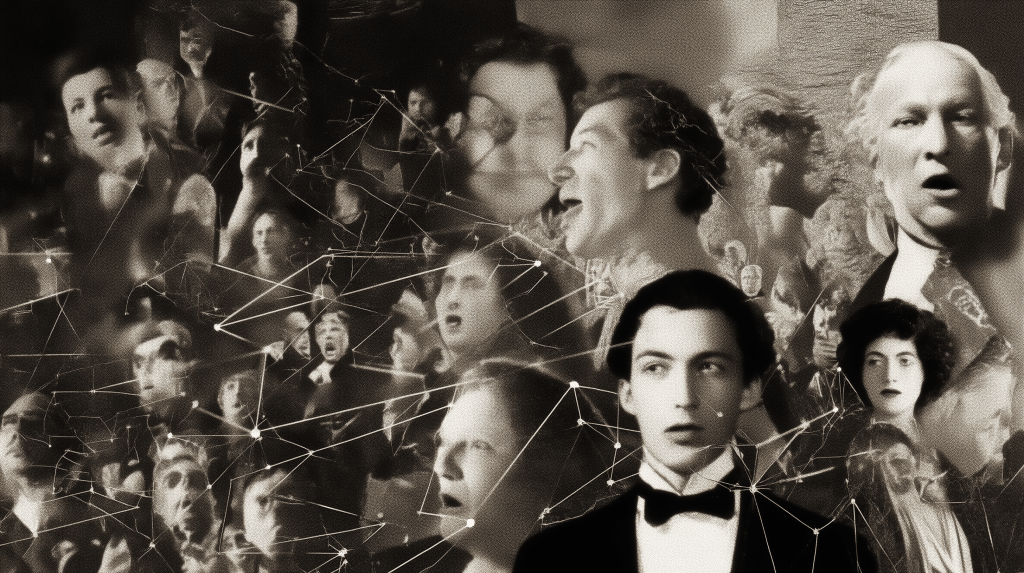
The advent of generative AI does not render the foundational principles of cinema obsolete; on the contrary, it elevates their importance. Classic film theory, developed over a century of practical and analytical work, provides the essential grammar and syntax required to communicate effectively with these new creative systems. The craft of filmmaking is undergoing a profound shift from physical execution—the arrangement of lights, cameras, and actors on a set—to conceptual instruction, where the director’s vision is translated into precise, descriptive language. In this new paradigm, the vocabulary of film theory becomes the operating system for the algorithmic auteur.
Hitchcock’s Ghost in the Machine: Engineering Suspense with AI
The techniques of Alfred Hitchcock, the “Master of Suspense,” were rooted in a deep understanding of audience psychology, visual storytelling, and the power of editorial juxtaposition. Generative AI tools provide a powerful new canvas for applying these principles with unprecedented speed and flexibility.
Suspense over Surprise: Hitchcock famously argued that true suspense is achieved by providing the audience with information that the characters in the film do not possess.26 This creates a state of anxious anticipation rather than a momentary shock. AI workflows are uniquely suited to realize this principle. A filmmaker can simultaneously generate multiple, parallel perspectives of a single narrative moment. For instance, one prompt could be, “A medium shot of a character nervously unlocking a door, their back to the camera.” A concurrent prompt could be, “A low-angle shot from inside the dark room, showing the shadow of a figure waiting behind the door.” By cutting between these two AI-generated shots, the filmmaker instantly creates a classic Hitchcockian suspense sequence, placing the audience in a position of superior knowledge and building tension without the need for complex on-set blocking or multiple camera setups.
The Kuleshov Effect: Hitchcock was a master of the Kuleshov effect, a cinematic principle demonstrating that meaning is created not by a single shot, but by the juxtaposition of shots.27 The classic example involves pairing a neutral shot of an actor’s face with different images (a bowl of soup, a child playing, a coffin) to evoke different emotions in the viewer. AI transforms this theoretical concept into a practical, iterative laboratory. A director can generate one high-quality, expressionless shot of a character’s face. They can then generate dozens of potential “insert shots” based on a wide range of prompts. The editing process becomes a rapid-fire experiment in emotional alchemy, allowing the filmmaker to test countless combinations to find the most powerful narrative effect—a process that would be prohibitively time-consuming and expensive to achieve with traditional photography.
Visual Storytelling & Camera Control: Hitchcock was a proponent of “pure cinema,” believing that a story should be comprehensible through visuals alone, with dialogue used for enhancement rather than exposition.27 He meticulously planned his camera work, often using a slow, deliberate movement “inward”—from a wide establishing shot to a medium shot and finally to a tight close-up—to gradually increase tension and focus the audience’s attention.27 Modern AI platforms are beginning to internalize this cinematic language. Tools like Runway Gen-3 offer explicit “Camera Control” features, allowing a user to include commands like “slow dolly in” or “high angle shot” directly in the prompt.13 This translates Hitchcock’s physical directing techniques into textual instructions. A vague prompt like “a scary scene” yields generic results. A prompt informed by classic film language—”A low angle shot of a man in a dark room, low-key chiaroscuro lighting casting long shadows, slow dolly zoom towards his face, creating suspense”—is far more effective because it provides the AI with specific, actionable cinematic commands.29 In this way, a deep understanding of film theory becomes a prerequisite for effective AI direction.
 AI Film Studio