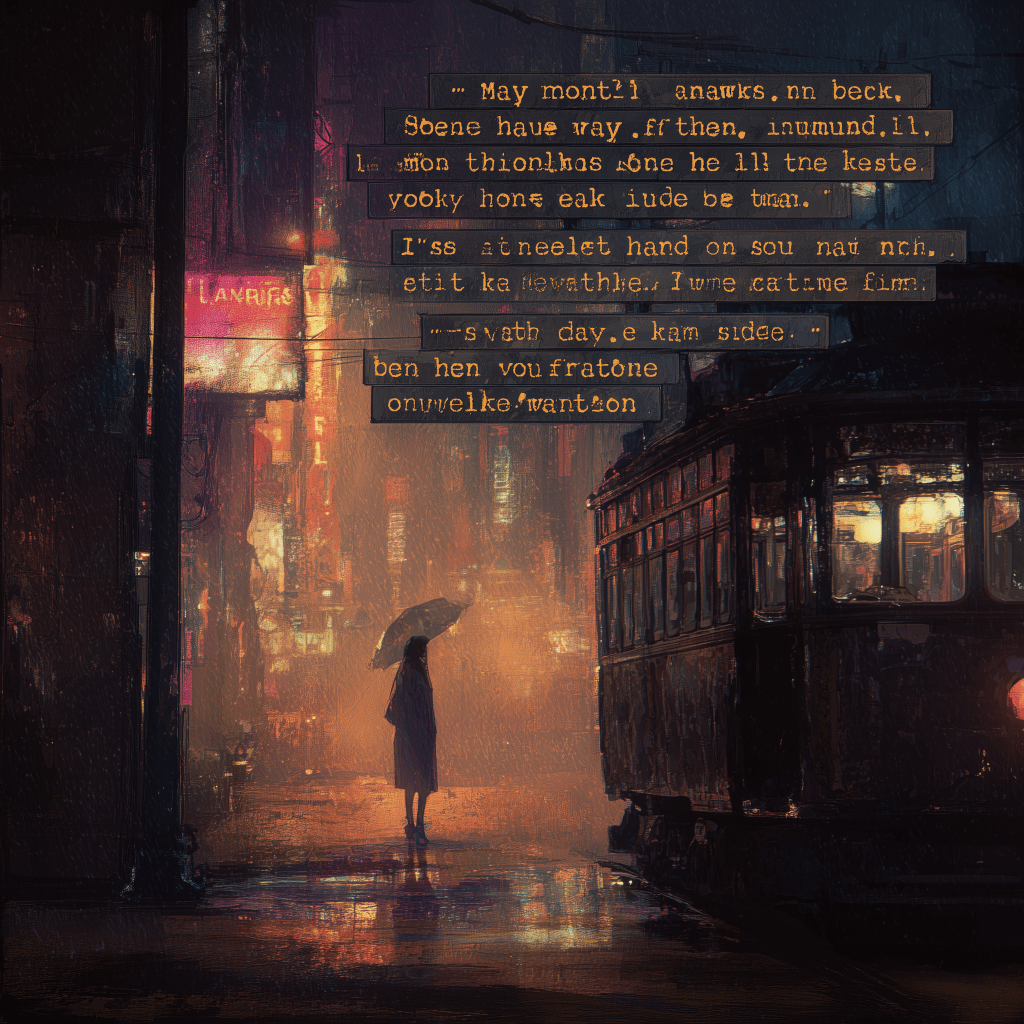
Story 1: “The Language Barrier”
Setup: Maya, a passionate indie filmmaker, relies on natural language prompts to create her deeply personal narratives. She crafts poetic, emotional descriptions: “A lonely woman walks through rain-soaked streets, her heart heavy with unspoken words.” Meanwhile, her former film school classmate David has embraced JSON prompting, treating filmmaking like code architecture with precise technical specifications.
Conflict: They’re both competing for the same prestigious AI film festival prize. Maya’s organic, intuitive approach produces beautifully imperfect, emotionally resonant films with unpredictable visual poetry. David’s JSON methodology yields technically flawless, cinematically sophisticated pieces with perfect camera movements and lighting, but they feel sterile and calculated.
Climax: During the final judging, Maya’s text-prompted film glitches at a crucial moment—the AI misinterprets her metaphorical language, creating an unintended but hauntingly beautiful visual error. David’s JSON film executes flawlessly but fails to move the audience.
Resolution: Both realize they need each other’s approaches. The story ends with them collaborating, combining Maya’s emotional intuition with David’s technical precision, discovering that the future of AI filmmaking lies in the marriage of human poetry and machine logic.
Theme: The tension between artistic intuition and technical control in creative AI tools.
Story 2: “Frame Rate”
Setup: Alex is a veteran documentary filmmaker who treats AI video generation like directing actors—speaking to the system conversationally, building relationships with their prompts over time. They know exactly how to phrase requests to get the emotional beats they want. Zoe is a former VFX supervisor who discovered JSON prompting and now treats every shot like a technical specification, controlling camera angles, focal lengths, and lighting with surgical precision.
Conflict: They’re both hired to create competing promotional films for the same tech startup in 48 hours. Alex begins with flowing, narrative-driven text prompts, building their film organically as they discover what works. Zoe immediately maps out every shot in JSON format, pre-visualizing the entire piece before generating a single frame.
Escalation: As the deadline approaches, Alex struggles with consistency—their beautiful, poetic prompts sometimes produce unwanted variations. Zoe’s technical approach is efficient but lacks the spontaneous human moments that make documentaries compelling. Both become increasingly frustrated with their chosen methods.
Twist: They accidentally see each other’s work-in-progress and realize they’re solving the same creative problems from opposite ends. Alex’s “mistakes” reveal emotional truth; Zoe’s precision enables complex visual storytelling impossible with text alone.
Resolution: In the final hours, they secretly share techniques. Alex learns to use JSON for crucial technical shots while maintaining their narrative voice. Zoe incorporates Alex’s conversational prompting for authentic human moments. Both films succeed, but in different ways, showing there’s no single “right” approach to AI filmmaking.
Theme: The evolution of creative tools requires adapting old skills while learning new languages.
Story 3: “Render Time”
Setup: Sam is an AI filmmaker who’s become famous for their “stream of consciousness” approach—typing raw, emotional text prompts live during film festivals, creating movies in real-time as audiences watch. Riley is a meticulous planner who spends weeks crafting elaborate JSON schemas, treating each film like a symphony where every element is scored and timed.
Conflict: They’re both invited to create a collaborative film for a major streaming platform, but their methodologies are completely incompatible. Sam wants to improvise and let the story emerge naturally through text prompts. Riley insists on pre-planning every shot, character arc, and visual effect through structured JSON.
The Experiment: The streaming platform proposes an experiment: they must create their film live, in public, with audiences watching their process. Sam will prompt the first half using natural language, Riley will JSON-prompt the second half, and somehow they must create a coherent story.
Crisis: Midway through, Sam’s intuitive approach has created compelling characters and emotional stakes, but the visual continuity is chaotic. Riley’s section begins with perfect technical execution but struggles to connect emotionally with Sam’s established characters. The audience watches as the film threatens to fall apart at the seam between their approaches.
Innovation: In desperation, they begin combining methods in real-time—Sam provides the emotional direction and character motivation through text, while Riley simultaneously translates these into JSON technical specifications. They discover they can work as a single creative entity: one mind providing heart, the other providing precision.
Resolution: Their final film becomes a landmark in AI cinema, demonstrating that the most powerful AI filmmaking happens when human creativity and technical mastery work in perfect harmony. The story ends with them starting a new production company based on their hybrid methodology.
Theme: True innovation happens when opposing approaches find synthesis rather than replacement.
Common Threads
Each story explores:
- The creative tension between intuition and precision
- How different tools shape artistic vision
- The evolution of filmmaking as AI becomes more sophisticated
- The irreplaceable value of human creativity in technological workflows
- The idea that the future lies not in choosing sides, but in integration
These stories could be filmed using the very techniques they explore, with the text-prompting sequences showing more organic, flowing visuals and the JSON sequences demonstrating precise technical control.
 AI Film Studio