How I Built a $10K/Month Marketing Department With Zero Employees
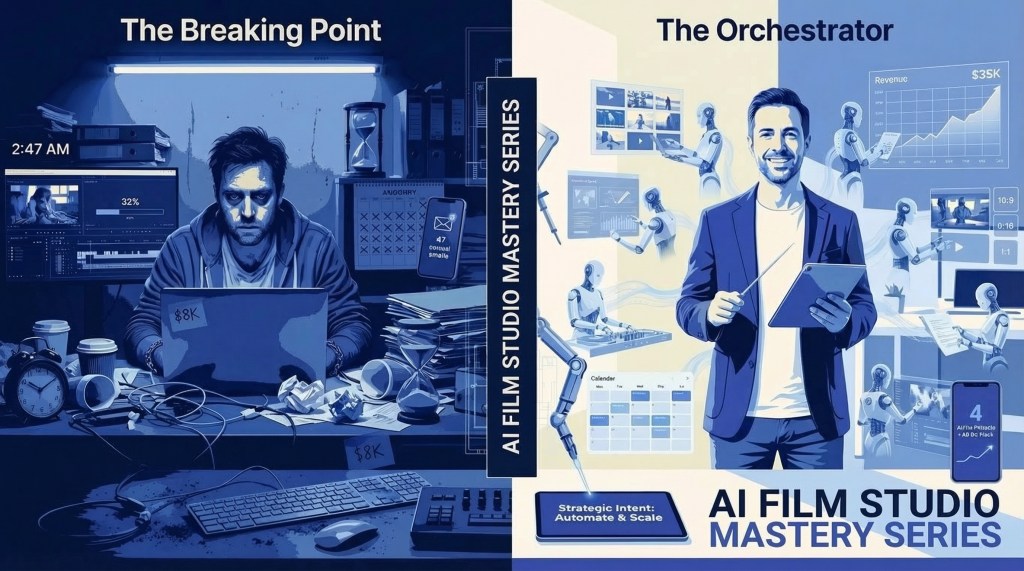
The Breaking Point
I remember the exact moment I realized I was doing this all wrong.
It was 2:47 AM. Again.
I was hunched over my laptop, scrubbing through the timeline of what was supposed to be a simple product demo video. Frame 2,847 of 8,920. My eyes burned. My coffee had gone cold hours ago. And my client call was in six hours.
This was the third night that week I’d sacrificed to the video production gods.
I’m James. I run a boutique consulting practice helping B2B SaaS companies clarify their messaging. Good money. Terrible margins. Because every insight I delivered, every strategy deck I created, every positioning framework I developed… died in silence.
My clients couldn’t execute on any of it.
They needed video content. Lots of it. Product explainers. Founder stories. Customer testimonials. Social proof compilations. Educational series. The works.
But they didn’t have in-house video teams. And agency rates ($5K-$15K per video) made consistent content production financially impossible.
So I did what any “helpful” consultant does: I started making the videos myself.
Terrible decision.
The Entrepreneur’s Trap: Trading Money for Time, Then Time for Nothing
Here’s what nobody tells you about being a solopreneur: you don’t have an income problem. You have a leverageproblem.
I was charging good rates. $8K-$12K per consulting engagement. But I was spending 60% of my delivery time on video production—work I wasn’t even billing for. It was “value-add.” Which is entrepreneur-speak for “slowly going bankrupt while looking busy.”
I tried the obvious solutions:
- Hired a video editor on Upwork: Three weeks of back-and-forth revisions for a 90-second video. The result was technically competent and creatively dead.
- Tried to productize with templates: Spent $2K on After Effects templates that still required hours of customization and made everything look like a 2018 explainer video.
- Looked into agencies: Got quotes that would consume 40% of my project margins. Math didn’t math.
The problem wasn’t finding people who could edit video. The problem was that I was the bottleneck. I had the vision. I understood the strategy. I knew what story needed to be told.
But I was trapped in execution hell—animating keyframes, color-correcting footage, syncing audio, rendering exports, reformatting for different platforms.
I wasn’t doing creative work. I was doing mechanical work.
And mechanical work doesn’t scale.
The Search That Changed Everything
Desperation makes you specific with Google searches.
I didn’t search for “AI video tools” or “easy video creation.” Those queries return garbage—consumer apps that make slideshows with stock footage and royalty-free music that sounds like an elevator had a nervous breakdown.
I searched for: “Automated Video Pipeline”
Because I wasn’t looking for a tool. I was looking for a system.
That search led me to a YouTube video titled something like “How to Build a Marketing Department in a Box Using AI Film Agents.”
The title alone stopped me mid-scroll. Not because it was hypey. Because it spoke my language.
Marketing department in a box.
That’s not creator-speak. That’s not artistic aspiration. That’s systems architecture. That’s scalable infrastructure. That’s what I needed.
The video was a free training session for something called the AI Film Studio Live Mastery Series.
I almost didn’t watch it. I’ve been burned by too many “masterclass” pitches that are just 90-minute sales funnels wrapped in content tissue paper.
But fifteen minutes in, the instructor said something that hooked me:
“You don’t need to learn how to edit video. You need to learn how to direct agents who edit video for you. The skill isn’t in the execution anymore—it’s in the orchestration.”
I stopped the video. Rewound it. Listened again.
That was it. That was the mental model shift I’d been missing.
From Execution to Orchestration: The $100K Insight
The course wasn’t teaching “AI video generation.” It was teaching workflow architecture.
Here’s what I learned in the first module that changed everything:
Traditional video production is a serial process: write script → record footage → edit → animate → color grade → sound design → export → upload → optimize for platform.
Each step requires specialized skills. Each step is a bottleneck. Each step costs time or money.
The AI Film Studio approach treats production as a parallel, agent-based system:
- Agent 1 (Script Architect): Takes my strategic brief and generates multiple script variations optimized for different goals (conversion, education, engagement).
- Agent 2 (Visual Director): Interprets script beats and generates scene-by-scene visual instructions—not just “what” to show, but cinematography style, composition, pacing.
- Agent 3 (Asset Generator): Creates or sources all visual elements—AI-generated footage, stock footage retrieval, graphic elements, based on the visual director’s specifications.
- Agent 4 (Editor): Assembles everything according to pacing blueprints, applying the narrative structure defined in my brief.
- Agent 5 (Audio Designer): Handles voiceover generation (or human voice integration), music selection, sound effects, mixing.
- Agent 6 (Optimizer): Creates platform-specific versions—16:9 for YouTube, 9:16 for TikTok/Reels, 1:1 for feeds, with appropriate text overlays and hooks.
Instead of me doing six jobs poorly, six specialized agents do six jobs excellently—simultaneously.
My role? I write the intent instruction.
A two-page brief that defines:
- Strategic objective
- Target audience and their pain points
- Key message architecture
- Narrative structure
- Brand voice and visual identity parameters
- Success metrics
That’s it. That’s the only creative work I do now.
The agents handle the drudgery. I handle the direction.
Building the Machine: My First Automated Pipeline
The course didn’t just teach concepts. It provided blueprints—actual workflow templates I could deploy immediately.
Week one, I built my first pipeline: a “Customer Success Story Generator.”
Input: 30-minute customer interview (recorded on Zoom)
Output (72 hours later, mostly automated):
- 3-minute case study video (YouTube)
- Six 30-second testimonial clips (LinkedIn)
- Ten 15-second social proof snippets (Instagram/TikTok)
- Written case study (pulled from transcript)
- Quote graphics (five variations)
Total hands-on time required from me: 4 hours (conducting interview + writing intent brief + final quality review).
Previously, that deliverable set would have taken me 30-40 hours of production time across two weeks.
The time savings alone was worth the course tuition ten times over.
But the real value wasn’t time savings. It was capacity unlocking.
The Business Model Shift
Here’s what happened next:
I stopped positioning myself as a consultant who “also does video.”
I started positioning as a consultant who delivers executable content systems.
My offer changed:
Before: “I’ll help you clarify your messaging and positioning.” ($8K-$12K)
After: “I’ll build you a 90-day content engine that produces 40+ video assets documenting your methodology, featuring your clients, and establishing your market position—and I’ll train your team to operate it.” ($25K-$35K)
Same strategic work on the front end. But now the deliverable isn’t a slide deck they’ll struggle to execute. It’s a functioning production system that starts generating content immediately.
My clients aren’t buying my time. They’re buying my methodology for orchestrating agents.
Revenue per project: 3x increase.
Time per project: 40% decrease.
Profit margin: Somewhere I’m not comfortable saying out loud.
The Solopreneur’s Ultimate Leverage
I now operate what looks like a marketing department:
- Content strategist (me, 4-6 hours per project)
- Video production team (AI agents, supervised)
- Graphic design team (AI agents, supervised)
- Audio production team (AI agents, supervised)
- Distribution specialists (AI agents + automation)
Total human headcount: 1 (me)
Total operational overhead: ~$400/month (software subscriptions)
The economic model is absurd. In the best way possible.
I’m producing at agency scale with solopreneur overhead.
What This Actually Requires (The Honest Part)
This isn’t a “push button, get rich” situation. Let me be clear about what this actually demands:
1. Systems thinking: You need to think in workflows, not tasks. If you love the craft of editing, this might feel soulless. If you love the craft of problem-solving, this is heaven.
2. Intent clarity: AI agents are brilliant executors and terrible mind-readers. You must be able to articulate what you want with precision. Vague briefs get vague results.
3. Quality standards: You’re the director. You review everything. The agents handle the mechanical execution, but you own the creative approval. Budget 10-15% of saved time for quality control.
4. Learning investment: The AI Film Studio course took me about 25 hours to complete (watching at 1.5x speed, pausing to implement). That’s a week of evenings. Not nothing. But compared to learning actual video editing? It’s a rounding error.
5. Comfort with “good enough”: AI-generated content won’t win Cannes Lions. But it will be more than good enoughfor 95% of marketing applications. Perfectionism is your enemy here.
The question isn’t whether AI can produce Scorsese-level filmmaking. The question is whether it can produce content that’s better than doing nothing—which is what most businesses currently do because production costs are prohibitive.
The answer is an emphatic yes.
The New Creator Class
There’s something profound happening that most people aren’t talking about yet.
We’re watching the emergence of a new creator archetype: The Director.
Not “director” like a film director who still needs to know camera operation and lighting. More like an orchestra conductor who doesn’t need to know how to play every instrument but understands exactly how they should sound together.
The old creator economy rewarded technical execution. If you could draw, edit, animate, or code better than others, you won.
The new creator economy rewards intent instruction. If you can articulate vision, architect workflows, and orchestrate agents more effectively than others, you win.
This isn’t about technology replacing creativity. It’s about technology removing the barriers between strategic vision and executed reality.
For the first time in history, the bottleneck isn’t access to production resources. It’s the quality of your strategic thinking.
That levels up the entire game.
Where I Am Now (Six Months Later)
Current state of the machine:
- Four active client engagements, each producing 12-15 video assets per month
- Total monthly recurring revenue: $42K
- Active production time from me: ~60 hours/month (15 hours per client)
- Everything else: automated agent workflows
I have a marketing department. But it doesn’t have email addresses or take vacation days.
It runs 24/7. It doesn’t get tired. It doesn’t have creative mood swings. It doesn’t need motivation or management.
It just needs clear direction.
And that’s the only thing I’ve ever actually been good at anyway.
The Real Lesson
If you’re a solopreneur reading this, here’s what I wish someone had told me two years ago:
Your scarcest resource isn’t money. It’s leverage.
Every hour you spend doing work that could be systematized is an hour you’re not spending on work that only you can do—the strategic thinking, the client relationships, the creative direction, the vision.
The AI Film Studio Mastery Series didn’t teach me how to make videos with AI.
It taught me how to architect systems that make videos for me.
That distinction is worth seven figures.
Maybe more.
James runs a boutique consulting practice helping B2B SaaS companies build executable content systems. If you’re interested in the AI Film Studio Live Mastery Series, you can find it at https://www.ai-film.studio/live-mastery-series. This is not an affiliate link. This is just the tool that changed how I work.
 AI Film Studio